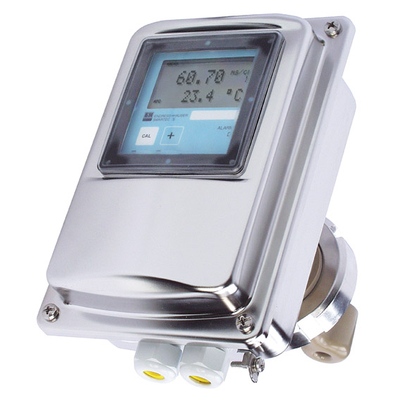
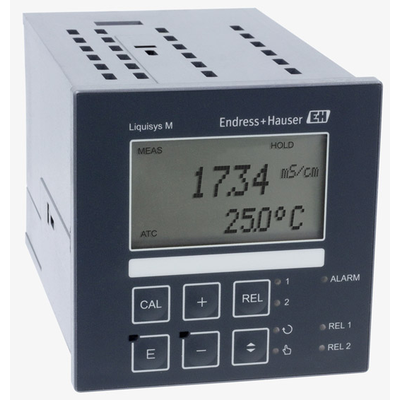
Liquisys M CLM223
Technical Data
CompareConductivity
| Measuring Principle | Conductive |
| Application | Water, waste water, process |
| Characteristic | 4-wire transmitter with a two-line display. |
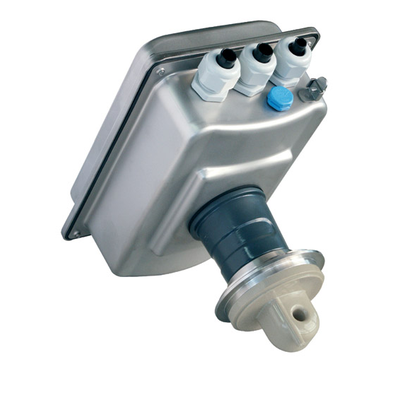
| Design | Panel-mounted transmitter for conductivity |
| Dimension | 96x96 mm, built-in-depth: 146 mm |
| Temperature sensor | Display and current output |
| Ex certification | No |
| Ingress protection | IP54 |
| Input | 1-channel transmitter |
| Output / communication | 0/4-20 mA, Hart, Profibus. |
| Certificates, declarations and approvals | CSA Gen. Purpose |
The Liquisys CLM223 is a standard transmitter for all analog conductivity sensors. Thanks to continuous plausibility checks and checks of the measuring process and the sensor, it increases operating safety. Whichever hardware and software modules are selected, e.g. relays and bus communication, it adapts perfectly to the measuring task. It also allows the transmitter to be upgraded at any time, and its simple menus and factory calibration make configuration and operation fast and convenient.
Benefits
-
Higher operating safety: continuous process check system, user-defined alarm settings and calibration plausibility check
-
Extensive functions: conductivity, resistivity and concentration measurement, ultrapure water monitoring in accordance with USP and EP standards
-
Convenient operation and service: intuitive user interface, simple calibration and manual contact control
-
Reduced maintenance effort: automatic cleaning triggered by alarms and limit switches (with Chemoclean)
-
Suitable for a wide range of applications: various extension options, such as P(ID) controllers, timers, etc., for all processes (conductive sensors)
Application areas
The Liquisys CLM223 transmitter can be used with various analog conductivity sensors and is suitable for non-hazardous-area measurement in the following industries and utilities:
-
Chemical industry
-
Food & Beverage
-
Life sciences sector
-
Power & Energy
-
Water & Wastewater
-
Primary raw materials & metallurgy
-
The Liquisys CLM223 uses the following communication protocols and interfaces:
-
0/4...20 mA
-
HART
-
PROFIBUS DP
-
PROFIBUS PA
Spare Parts & Accessories 40
40 spare parts · click to expand
| Order code | Description | |
|---|---|---|
| 51511446 | 继电器模块Upgrade of LIQUISYS-M basis version by 2 floating changeover contacts. | Enquire |
| 51500320 | 继电器输出模块Upgrade of LIQUISYS-M basis version by 2 floating changeover contacts. | Enquire |
| 51500321 | 继电器输出电路板Upgrade of LIQUISYS-M basic version by 4 floating changeover contacts. | Enquire |
| 71129943 | ***Kit CxM2x3: realy modul 4 R prot. coaUpgrade of basic function of LIQUISYS-M with 4 dry changeover contacts eletronics with protection coating | Enquire |
| 51511447 | 继电器模块 | Enquire |
| 51504304 | 继电器输出模块Upgrade of LIQUISYS-M basic version by 2 contacts and current input 4-20mA. | Enquire |
| 51504305 | 继电器输出模块Upgrade of LIQUISYS-M basic version by 4 contacts and current input 4-20mA. | Enquire |
| 51500317 | CXM2X3 交流电源KIT CXM2X3 power supply AC | Details |
| 71129939 | ***KIT CXM2X3 power supply AC prot.coatiCxM2x3 power supply 100/115/230 V AC eletronics with protection coating | Enquire |
| 51500318 | CXM2X3 直流电源KIT CxM2x3 power supply DC | Enquire |
| 51501075 | CXM223 外壳附件Kit CXM223 housing assembly | Details |
| 51501076 | CXM223 机械外客部件KIT CXM223 Mechanical housing parts | Enquire |
| 51502124 | CXM223 侧板Kit CXM223 side wall | Details |
| 51502513 | CXM223 Profibus DP 底盖Kit CXM223 End frame Profibus DP | Details |
| 51501086 | CXM223 接地端子排KIT CXM223 Ground terminal strip | Enquire |
| 51501078 | CXM223 端子排KIT CXM223 Terminal strip | Enquire |
| 51501206 | ***Kit MKIC Conductivity transmitterKit MKIC Conductivity transmitter | Enquire |
| 51501210 | CLM2x3 主板KIT CLM2x3 Central module I1 conductive | Enquire |
| 51501213 | CLM2X3 传导式模块KIT CLM2X3 Conductive modul I1 HART | Enquire |
| 51501212 | CLM2X3 传导式模块KIT CLM2X3 Conductive module I2 | Enquire |
| 51501214 | CLM2X3 传导式模块KIT CLM2X3 Conductive module I2 HART | Enquire |
| 51501215 | CLM2X3 主模块KIT CLM2X3 cen. module Profibus PA cond. | Enquire |
| 51502502 | Kit CLM2X3 主模块Kit CLM2X3 central module ProfibusDPkond | Enquire |
| 71134726 | Kit CLM2x3: Centralm. cond. PBDP;H/W2.1xContent: 1x Central module Profibus DP Module name: LSCP-DP qualifired from H/W 2.10 | Enquire |
| 71134732 | 继电器模块Content: 1x Relay module Profibus DP 2x Relay, 1x Current input DP connection qualified from H/W 2.10 | Enquire |
| 51501216 | CLM2x3 感应式模块KIT CLM2x3 inductive module I1 | Enquire |
| 51501219 | CLM2x3 感应式模块KIT CLM2x3 Inductive modul I1 HART | Enquire |
| 51501218 | CLM2x3 感应式模块KIT CLM2x3 Inductive module I2 | Details |
| 51501220 | CLM2x3 感应式模块KIT CLM2x3 Inductive module I2 HART | Enquire |
| 51501221 | CLM2X3 主模块KIT CLM2X3 cen. module Profibus PA ind | Enquire |
| 51502501 | Kit CLM2X3 主模块Kit CLM2X3 central module Profibus DPind | Enquire |
| 71134727 | Kit CLM2x3: Centralm. ind. PBDP; H/W2.1xContent: 1x Central module Profibus DP Module name: LSCP-DP qulaifired from H/W 2.10 | Enquire |
| 51501203 | CLM223 端子排KIT CLM223 terminal strip set | Enquire |
| 51502126 | KIT CLM223 端子排KIT CLM223 terminal strip Profibus PA | Enquire |
| 51502493 | Kit CLM223 端子排Kit CLM223 terminal strip, Profibus DP | Enquire |
| 71071440 | Kit CxM223: Front foil + 6 key lifters | Enquire |
| 51500385 | 扩展软件升级包Upgrade of LIQUISYS-M basic version (parameter pH,Cond.,Tu,CL,O2 (WX to WS)) to S-version (plus-package). Serial number of instrument needed. | Enquire |
| 51500963 | "清洗功能”升级包Upgrade of LIQUISYS-M basic version by cleaning functionality (Chemoclean) (serial number of instrument needed). If not yet installed, a 4-relay board must be ordered separately (51500321). | Enquire |
| 71161133 | 变送板 | Details |
| 50047795 | 壳体安装支架 | Details |
Configurator / Comparison
A
Source: public information from the Endress+Hauser website
Measuring principle video
 Click to play
Manuals & Documents 9
All documents for this model9 documents · click to expand
Liquisys M CLM223/253 操作手册 Chinese
Liquisys M CLM223/253 Operating Instructions English
Operating Instructions Liquisys M CXM223/253 PROFIBUS English
Operating Instructions Liquisys M CLM 223/253 English
Operating Instructions Liquisys M CXM223/253 HART English
技术资料 Liquisys M CLM223/253 Chinese
技术资料 Liquisys M CLM223/253 Chinese
Liquisys M CLM223/253 Technical Information English
Technical Information LIQUISYS English
Case Studies
Municipal Wastewater Treatment · conductivity — Application Case
Customer Profile
The typical setting in Municipal Wastewater Treatment is the inlet, biological and outlet stages of a municipal plant. The measuring point is conductivity; the focus is measuring conductivity to judge water purity or chemical concentration.
Key Difficulties
Conditions are high solids and corrosive fractions, with large diurnal flow swings and, on top of that, effluent parameters drift and probes foul with sludge and biofilm, which a standard configuration cannot handle for long. The design therefore starts with choosing two- or four-electrode cells by range and corrosivity.
Implementation
The scope ran through the analyser range: selecting as part of a complete water-analysis system. Technically it hinges on choosing two- or four-electrode cells by range and corrosivity, and on these requirements: stable compliance with Grade 1A discharge limits and online data reporting.
Customer Benefit
In practice this means stable concentration control and less reagent and discharge waste, which cut the workload on the site maintenance team.
Food & Beverage · conductivity — Application Case
Project Background
The project covers dosing, pasteurising, filling and CIP stages. The work centres on conductivity and the core task is measuring conductivity to judge water purity or chemical concentration.
Operating Challenges
The medium and duty are characterised by syrups, dairy and beverages that scale easily, under strict hygienic requirements, and frequent cleaning demands instruments that withstand hot CIP/SIP caustic cycles. So conductivity cannot be specified generically — it calls for choosing two- or four-electrode cells by range and corrosivity.
Solution
The Ainstru engineering team worked through the analyser range: selecting as part of a complete water-analysis system. The configuration involves choosing two- or four-electrode cells by range and corrosivity, with these requirements in view: food-safety and hygienic design per 3-A / EHEDG.
Results
Since start-up the system has run steadily; the practical result is stable concentration control and less reagent and discharge waste.
Chemical & Pharmaceutical · conductivity — Application Case
Project Overview
The site is reactors, metering vessels and finished-product tanks. The customer wanted conductivity properly configured on the existing plant, with the aim of measuring conductivity to judge water purity or chemical concentration.
Technical Challenges
What actually causes trouble is highly corrosive media with solvents and crystallisation, partly in explosive atmospheres, and corrosion plus Ex protection shortens instrument life and makes downtime costly. All of this means the conductivity configuration has to involve choosing two- or four-electrode cells by range and corrosivity.
Configuration
Supply and installation were organised through the analyser range: selecting as part of a complete water-analysis system. On site this meant choosing two- or four-electrode cells by range and corrosivity, checked line by line against: Ex certification and GMP traceability of records.
Performance
After commissioning the outcome is stable concentration control and less reagent and discharge waste, and the readings are now used for process tuning.
Power & Energy · conductivity — Application Case
Site Conditions
This is a Power & Energy customer whose plant is at boiler feedwater, turbine condensate and FGD/DeNOx systems. The main task was measuring conductivity to judge water purity or chemical concentration.
The Problem
The difficulty lies in high temperature and pressure with both steam and saline water; at the same time drift under high temperature and pressure, with very costly unplanned outages. Specification therefore means choosing two- or four-electrode cells by range and corrosivity.
What We Did
We took a analyser range approach — selecting as part of a complete water-analysis system. Delivery was built around choosing two- or four-electrode cells by range and corrosivity, with point-by-point checks on: compliance with power-industry codes and unit availability targets.
Operating Outcome
In service the system performs as intended — stable concentration control and less reagent and discharge waste, with routine maintenance falling noticeably.