
Thermal Resistance
1. Two-wire lead method
The form of connecting a lead at each end of the thermal resistance element is called a two-wire system. Due to the simple wiring and low cost of the two-wire system, many thermal resistance products use this lead form. But in use will bring in the lead resistance of the additional error. And in the use of lead and connecting wire should not be too long. Moreover, due to the existence of lead resistance in the connecting wire, the resistance of the whole circuit is the resistance value of the thermal resistance plus the resistance value of the wires at both ends, so the measurement error is related to the material and length of the wires, so the two-wire lead method is only suitable for occasions with low measurement accuracy. If the length of the lead wire of the thermal resistance element is greater than 500mm, it will bring measurement error. Therefore, for the thermal resistance with the lead wire length above 500mm, the three-wire lead method is used instead, so that the error caused by the lead wire resistance can be effectively eliminated in the temperature measurement process.
2. Three-wire lead method
Connect two leads at one end of the thermal resistance temperature sensing element, and connect a lead at the other end. This type of lead is called a three-wire system. It can eliminate the influence of the inner lead, and the measurement accuracy is higher than that of the two-wire system. It is often used in occasions where the temperature measurement range is narrow, the wire is too long, or the temperature of the wire wiring is easy to change. The three-wire lead method is often used in conjunction with the bridge circuit. A wire is connected to the two bridge arms of the bridge, and the other wire is connected to the power supply of the bridge, which eliminates the influence of the change of the lead resistance. That is, the three-wire lead method can reduce or eliminate the measurement error caused by the change of the lead resistance.
3. Four-wire lead method
Two lead wires are connected to each of both ends of the thermal resistance element in a four-wire system. Two of the leads provide a constant current for the thermal resistance, convert the resistance into a voltage signal, and then lead the voltage signal to the measuring instrument through the other two leads. It can be seen that this lead method can eliminate the influence of the resistance of the lead, but its structure is complex, and the four-wire system is used only in high-precision temperature measurement. It is mostly used in laboratories, but it is also used in industrial production.
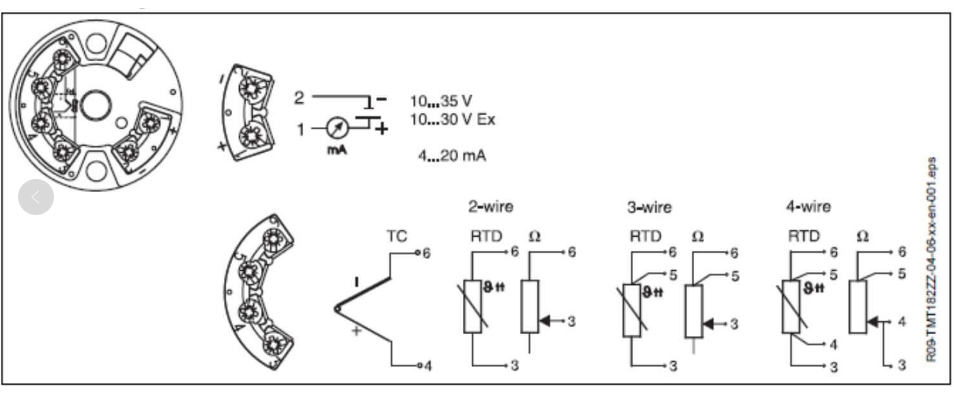
4. Wiring of thermal resistance in E H temperature transmitter: